Global South
Heightened vulnerability, historical responsibility and the quest for recognition in global decision-making.
What Is the Global South?
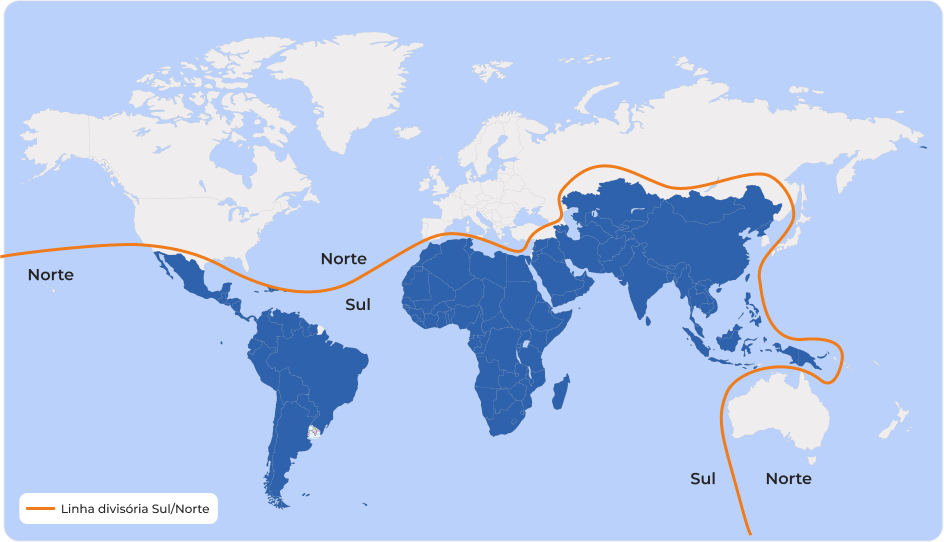
The term Global South refers to a group of countries whose trajectories have been shaped by economic inequalities, histories of colonization or external dependence, and relatively limited power in the international system. Although the term does not refer solely to geographical location, as many “countries of the South” are situated at different latitudes, the concept has a political and historical dimension. It highlights how these countries have been systematically marginalized in global development processes and in the decisions that shape the international system.
In the context of climate change, recognizing the Global South is essential to understanding:
- the differentiated historical responsibility, since much of the accumulated greenhouse gas emissions came from the economies of the Global North;
- the heightened vulnerability of Global South countries to climate impacts such as droughts, floods, and other extreme events, even though their per capita emissions are much lower than those of countries in the Global North;
- the need for a perspective that goes beyond a rigid North/South distinction, recognizing the diversity of realities within the Global South (large emerging economies, middle-income countries, and low-income nations) and their respective capacities, challenges, and priorities.
In adopting this term, the Global South Climate Ambition Observatory proposes a South-centered perspective that takes the experiences of the Global South as its starting point for understanding climate policies, negotiations, and ambitions. The term is therefore analytical as well as political: it serves both to explain the asymmetries that structure the international climate system and to advance an agenda of climate justice and solidarity among the peoples of the South, one that demands recognition, finance, and a voice in decision-making in global responses to the climate crisis.
What Do We Mean by Climate Ambition?
Climate ambition refers to the set of targets, commitments, policies, and strategies that countries adopt to address the climate crisis, covering both emission reductions (mitigation) and adaptation to impacts that are already unavoidable. Under the Paris Agreement (2015), this ambition is expressed in Nationally Determined Contributions (NDCs), documents in which each country sets out its emission reduction commitments and the policies to achieve them. NDCs are to be updated every five years, with each new round reflecting a higher level of ambition. NDCs, together with long-term strategies (LTS), therefore form the basis for assessing national climate ambition.
At the Global South Climate Ambition Observatory, the monitoring and analysis of climate ambition are organized around seven main thematic areas:
- Emissions profile: analysis of the composition, sources, and trends of greenhouse gas (GHG) emissions, including variations across sectors (energy, agriculture, land use, industrial processes, and waste).
- Energy mix: study of the predominant energy sources, the role of fossil fuels, and the expansion of renewable energy, including the social, environmental, and economic implications.
- Nationally Determined Contributions (NDCs): tracking of the targets and commitments each country has made under the Paris Agreement, assessing their ambition, consistency, and conditions for implementation.
- Just transition: analysis of policies, plans, and initiatives that seek to reconcile decarbonization with job creation, social inclusion, and the protection of vulnerable communities.
- National adaptation plans and policies: assessment of national adaptation strategies, action plans, and measures to prevent and respond to climate impacts already under way.
- Long-term strategies (LTS): examination of long-term decarbonization targets and pathways, particularly regarding net-zero emissions.
- Vulnerability and climate risks: identification of the groups, sectors, and territories most exposed to climate impacts, and analysis of institutional capacity for response and resilience.