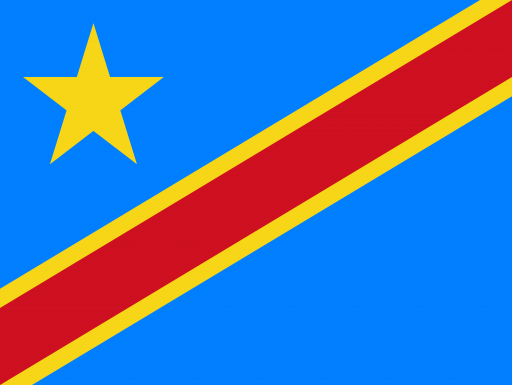
Democratic Republic of the Congo
Emissions profile
According to Climate Watch (2026), the Democratic Republic of the Congo (DRC) accounts for just over 1% of global greenhouse gas (GHG) emissions, ranking as the world's 12th largest emitter and the largest on the African continent, with 260.51 million tonnes of carbon dioxide equivalent (MtCO₂e) emitted in 2023. In per capita emissions, the DRC emitted approximately 2 tonnes of CO₂e per inhabitant (tCO₂e/inhabitant).
According to the most recent data from the International Energy Agency (IEA, 2026), the DRC is currently the world's 39th largest emitter of methane (CH₄), one of the most potent GHGs. With total emissions estimated at 1,566 kilotonnes (kt) in 2025, most (54%) come from the energy sector.
Despite its high emissions, the DRC faces significant levels of poverty, and only about one-fifth of its population has access to electricity (Carbon Brief, 2025).
The DRC is among the six countries with the highest forest-related emissions, ranking third among developing nations (WRI, 2025). The country is home to about 60% of the world's second-largest tropical forest: the Congo Basin forest.
This shapes the country's emissions profile, most of which is concentrated in the sector known as LULUCF (land use, land-use change and forestry), covering emissions from land use, land-use change and forests/forestry. These emissions predominantly result from deforestation. In the DRC, the main drivers of deforestation are small-scale agriculture, timber extraction for firewood and charcoal production, and mining activities (WWF, 2021).
The sectors responsible for the DRC's emissions are therefore distributed as follows (Climate Watch, 2026):
- Land use, land-use change and forestry – LULUCF (68%) – 177.36 MtCO₂e;
- Energy (11%) – 28.74 MtCO₂e;
- Agriculture (11%) – 27.76 MtCO₂e;
- Waste (8%) – 21.27 MtCO₂e;
- Industrial processes (2%) – 5.37 MtCO₂e.
Energy Mix
The energy matrix of the Democratic Republic of the Congo is overwhelmingly dominated by biofuels and waste. According to data from the International Energy Agency (IEA, 2026), in 2024 this category accounted for about 95% of total energy supply. Total supply is distributed as follows:
- Biofuels and waste (95%) – 1,734,908 TJ;
- Hydropower (3%) – 48,481 TJ;
- Oil and oil products (3%) – 48,390 TJ;
- Solar, wind and other renewables (<1%) – 105 TJ.
The country's electrification rate is only 22%, one of the lowest in the world (World Bank, 2023). However, regarding electricity generation, the Democratic Republic of the Congo (DRC) ranks 1st out of 198 countries in terms of the share of renewable sources in its electricity mix (Climate Watch, 2026). According to the IEA, approximately 99% of the country's electricity is generated from renewable sources. Electricity generation is dominated by hydropower, which accounts for 98% of the country's electricity generation, equivalent to 13,467 gigawatt-hours (GWh) (IEA, 2026).
The DRC ranks last among the 120 countries analyzed in the World Economic Forum's Energy Transition Index (ETI) (WEF, 2026). This index measures both the performance of the energy system, considering aspects of security, equity, and sustainability, and the level of readiness for the transition, which involves factors such as infrastructure, public policy, and capital availability. The DRC's ranking indicates that the country still lacks the structural, institutional, and financial conditions needed to make significant progress toward a low-carbon energy system.
Climate Ambition
Latest updates
2021 NDCLAST UPDATED: DEC/2021. As of October 2026, the DRC had not yet submitted the mandatory update to its NDC. As a result, the 2021 NDC (the date of the last update) remains in force.
The DRC submitted its first NDC in 2017 and submitted an update in December 2021. This second version is considered more comprehensive and detailed than the original. The document reinforces the country's strategic role as one of the world's largest carbon sinks, owing to the Congo tropical forest.
The latest NDC emphasizes both mitigation actions and adaptation measures, with special attention to the vulnerability of local communities and populations living in poverty. It is also the first time the DRC explicitly mentions the need for robust international support to enable its targets.
The country states that its NDC is aligned with the 2022–2026 National Development Plan and with forestry and energy management policies. Economic diversification and the sustainable use of natural resources are highlighted as the country's objectives, seeking to integrate mitigation, climate adaptation, food security, biodiversity conservation, and the expansion of access to clean energy.
Mitigation
-
2017First NDC
-
Updated NDC2021
-
2030Cut emissions by 21% from BAU
The DRC has committed to reducing its GHG emissions by 21% by 2030, relative to the business-as-usual (BAU) or status quo reference scenario—that is, what would occur if the country adopted no new mitigation measures. Of this total, 19 percentage points correspond to a conditional target, dependent on external financing, investment and technology transfer, while only 2 percentage points are unconditional, achieved through domestic policies. This corresponds to an estimated mitigation level of up to 650 MtCO₂e by 2030 (DRC, 2021).
The country also has sectoral mitigation targets for four sectors: energy, agriculture, forestry and land use, and waste.
In the forestry sector, the mitigation potential is 182 to 192 MtCO₂e by 2030, through the reforestation of about 4 million hectares, including local community forests, and through control over legal and illegal logging.
In agriculture, the estimated reduction ranges between 180 and 187 MtCO₂e, from mitigating emissions in agricultural areas within forests. This includes crop-rotation practices and promoting the relocation of agricultural activities to savannas, covering both small- and large-scale farming as well as subsistence agriculture.
In the energy sector, the mitigation target is 45 to 55 MtCO₂e, based on more efficient charcoal production and consumption, as well as the installation of hydroelectric plants to serve at least 5 million households.
Lastly, in the waste sector, the target is 37 MtCO₂e, with strategies focused on rational waste management, energy recovery, and commercial-scale composting.
As it did not update its NDC in 2025, the DRC has not yet set a mitigation target for 2035.
NDC Challenges and Criticism
The DRC’s 2021 NDC represents an advance over its previous 2017 document, which set a 17% emissions-reduction target. Despite the more ambitious 21% target, the country’s emissions are projected to remain higher than current levels by the end of the decade—an outcome that would not meet the Paris Agreement’s objective (Carbon Brief, 2025).
A central challenge is the strong dependence on external financing, which conditions much of the presented targets. Access to climate finance for developing countries such as the DRC remains limited relative to what is needed (WFF, 2024), and the success of the Congolese NDC will depend on establishing solid climate governance mechanisms, applying socio-environmental safeguards, and controlling the predatory exploitation of natural resources.
The DRC holds considerable climate potential, especially through the preservation of the Congo Basin and the expansion of clean energy sources, supporting the country's energy transition. To realize this potential, it is essential to mobilize significant climate finance and ensure that policies are implemented transparently and inclusively.
In 2025, the country officially launched a project supported by the Initiative for Climate Action Transparency, aimed at strengthening national climate change transparency frameworks (CAT, 2025).
It should be noted that the DRC is not yet assessed by the Climate Action Tracker (CAT), the reference platform for evaluating climate ambition in the Global South.
Long-Term Strategy (LTS)
The DRC does not have a Long-Term Strategy (LTS) under the Paris Agreement.
Just Transition
No official DRC documents were found presenting a national definition of the term.
However, just transition is a central theme for the DRC, especially given its strategic role in producing minerals essential to the global energy transition. The country accounts for about 70% of world cobalt production and ranks third among the largest copper producers, in addition to holding significant reserves of tin, tantalum and lithium—all minerals critical to clean-energy technologies, whose demand is expected to grow significantly in the coming years (EITI, 2022).
However, the exploitation of these resources takes place amid intense internal and regional conflicts, involving even neighboring countries such as Rwanda (Alma Preta, 2025; Human Rights Watch, 2025). Armed groups financed by the illegal trade of these minerals perpetuate violence and instability in the country, worsening human rights violations and offering no guarantee of fair wages, safe working conditions, or health protection (IndustriALL, 2024). The DRC is also considered the most dangerous country on the African continent for land and environmental defenders, especially due to mining activities (Global Witness, 2025).
Against this backdrop, the global energy transition creates an urgent need for a just transition in the DRC: one that combines environmental sustainability with social equity and, above all, addresses the injustices and violence already faced by the Congolese population. This requires strengthening governance and transparency in supply chains, respecting human and labor rights, implementing adequate mining-waste management practices, and reducing GHG emissions (World Bank, 2023). In other words, it is essential to ensure that the advancement of the global energy transition does not come at the cost of perpetuating inequalities and violations in the DRC.
Adaptation Plans
In the Democratic Republic of the Congo, the main guiding policy for climate action and adaptation is the 2021 National Adaptation Plan (NAP). The document was also submitted to the UNFCCC and has been available on the NAP portal since 2022. The DRC, a country with a strong dependence on subsistence agriculture and a large share of its population living in social vulnerability, structured its NAP with a focus on increasing community resilience to the intensification of extreme events, ecosystem degradation, and impacts on food security.
The DRC's adaptation plan also sets priority actions through 2030, with periodic updates envisaged, covering critical sectors such as: agriculture and food security, forests, biodiversity, water, health, energy, infrastructure and disaster-risk management. In parallel, the National Strategy for Reducing Emissions from Deforestation and Forest Degradation (REDD+) plays a central role, given that the country is home to the world's second-largest tropical forest, essential for both mitigation and climate adaptation.
As a result of these policies, the DRC has been working to develop climate monitoring and sectoral vulnerability systems, in partnership with international bodies such as UNDP and the World Bank. These systems aim to provide integrated data to guide government decisions, support civil society, and expand cooperation with the private sector. The analyses include current and future risks (for 2030 and 2050), especially in areas such as: water resources, agriculture, public health, and urban and energy infrastructure.
The country, however, still faces strong institutional, financial and technical limitations in fully implementing its climate strategies. Dependence on external financing, political instability, and governance challenges hinder the consolidation of a robust adaptation system. Even so, the DRC seeks to align its efforts with the 2030 Agenda and the Paris Agreement, reinforcing the importance of international support to strengthen its climate response capacity.
Climate Vulnerability and Risk
Score: 30.4
Resilience index
by 2050
Vulnerability index
Main climate threats
The University of Notre Dame's ND-GAIN Index recognizes the DRC as highly vulnerable to the impacts of climate change, ranking it 185th among the 190 countries assessed. According to the World Bank's Climate Risk Profile (2022), Congolese climate vulnerability represents a significant threat to both economic growth and social stability in a country that already faces structural and institutional challenges.
With a territory of about 2.3 million km² and great ecological diversity, climate risks in the country vary by region. While Kinshasa and riverside areas suffer from recurring floods that are expected to intensify, regions in southeastern Congo face prolonged droughts and soil degradation, affecting agricultural production and food security (World Bank, 2022).
Changes in rainfall patterns, rising temperatures and extreme events put pressure on infrastructure, the economy and vulnerable populations. Subsistence agriculture, the basis of much of the country's livelihoods, is especially affected. At the same time, the Congo Basin forest, the world's second-largest tropical forest, suffers from deforestation, mining and agricultural expansion (FAO, 2023).
The World Bank also points to the country's high vulnerability to floods, landslides and climate-related epidemics. Projections indicate that the DRC's average annual temperature could rise by between 1.7°C and 3.0°C by 2050, accompanied by greater rainfall variability, meaning both the risk of severe drought in certain regions and the intensification of flooding in riverside areas.